
Adam’s Polishes Mini Air Cannon Car Dryer Blower is the best blower for car detailing for most buyers because its compact design makes it easier to direct air into mirrors, grilles, and panel gaps. This handheld vehicle dryer targets trapped water without the bulk of a larger workshop blower, making it practical for home garages and quick finishing work. Its smaller format can mean less coverage per pass, so owners with several vehicles may prefer a larger unit.
This guide is for car owners, weekend detailers, and professionals comparing dedicated drying tools. The biggest factors are airflow strength and power source, since they affect drying speed, reach, and work time between charges or cord adjustments. The five picks below are ranked, with clear reasons and honest drawbacks for each. They cover compact handheld models, stronger shop-style options, and tools suited to careful paint-safe drying.
Quick Comparison
| # | Product | Best For | Price | |
|---|---|---|---|---|
| 1 | Adam's Polishes Mini Air Cannon Car Dryer Blower | Small-car owners with tight storage | ~$105 | View → |
| 2 | Adam's Polishes Air Cannon Car Dryer Blower | Large-vehicle detailers needing more reach | ~$285 | View → |
| 3 | SHELANDY Motorcycle & Car Dryer | Motorcycle riders and weekend washers | ~$95 | View → |
| 4 | HI-TECH Vortex II Air Cleaning Gun | Dust removal from vents and crevices | ~$36 | View → |
| 5 | Car Detailing Air Blow Gun | Budget-minded home detailers | ~$36 | View → |
5 Top Car Detailing Blowers
This ranked list counts down from capable car-drying blowers to the top pick, with power, control, and detailing usefulness guiding each placement.
5. Car Detailing Air Blow Gun

Best for: DIY car interior and wheel cleaning
This compressed-air cleaning gun helps clear dust, grit, and loose debris from dashboards, cup holders, carpets, floor mats, door jambs, wheels, and other tight areas. It requires an air compressor, so it is better suited to a garage than roadside cleaning. The kit includes one tapered nozzle, one soft dusting brush, and three connectors for Europe, the USA, and Japan. Around $36, it costs more than a basic hand duster but offers more control for detailed work.
The aluminum-alloy barrel and nozzle should handle regular shop use, while the copper connector and ball valve add sturdier hardware at the air connection. A 360-degree swivel helps direct airflow around awkward corners. The pistol grip and included C-hook make the tool easier to handle and store. Use it about 1 to 10 centimeters from the surface. The instructions call for 6 to 8 kgf/cm² of pressure and warn not to exceed 10 kgf/cm². Always keep the airflow away from people and children.
Pros
- Includes a tapered nozzle and soft brush for both broad blasts and delicate corners.
- Aluminum construction, copper fittings, and a 360-degree swivel support repeated detailing work.
- Three air connectors improve compatibility with different compressor setups.
Cons
- It cannot operate by itself. You need a compatible air compressor and the correct connector.
- High-pressure air can scatter dust into the cabin, and careless use may push debris deeper into vents or seams.
4. HI-TECH Vortex II Air Cleaning Gun

Best for: Frequent car interior detailing
The HI-TECH Vortex II is an air-powered cleaning gun for carpets, upholstery, dashboards, vinyl, leather, and engine bays. It connects to an air compressor and uses a pulsing vortex motion to loosen dust, grease, and grime from fabric fibers and narrow gaps. At around $36, it offers a lower-cost option than many shop-focused detailing tools.
A switch lets you choose between wet cleaning and dry air-only operation. That makes it possible to apply cleaning solution, agitate the surface, then blow away moisture without swapping attachments. The design also aims to spread solution across more of the surface, so you may use less product during each job. Its rugged components suit repeated garage or shop use, but the tool still depends on a compressor with the right connection and enough air capacity. The product description does not provide required pressure, air-consumption figures, hose size, or body dimensions, so buyers should confirm compatibility before ordering.
Pros
- Two operating modes support wet scrubbing and dry air cleaning.
- Vortex motion reaches carpet fibers, upholstery seams, vents, and other tight areas.
- Works across interiors, exterior surfaces, and engine bays with less need for separate tools.
Cons
- It requires a separate air compressor, which adds cost, noise, and storage needs.
- No pressure or airflow requirements are listed, making compressor compatibility harder to judge.
3. SHELANDY Motorcycle & Car Dryer
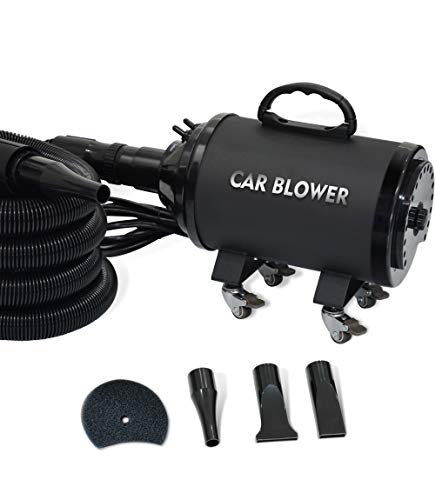
Best for: Motorcycle owners drying tight engine areas
The SHELANDY is a powered air dryer for motorcycles and cars. Its 2,800-watt motor runs on 110 volts and pushes air through a 14-foot flexible hose. Built-in wheels make the unit easier to move around a garage or driveway. Variable airflow and temperature controls let you use gentler settings on sensitive areas or more force around wheels, frames, and engine parts.
Its main advantage is reach. The long hose can get between body panels, around engine components, and into other spaces where towels struggle. Blowing water away also reduces the need to rub painted or polished surfaces, which may help limit smears and light scratching. The dryer also works for dusting and general detailing. At around $95, it costs more than a basic electric blower, but the hose, wheels, and heat controls add useful flexibility. A one-year replacement warranty provides some coverage, though the warranty period is limited.
Pros
- 14-foot hose: Reaches engine bays, wheel areas, and narrow motorcycle spaces.
- Variable speed and temperature: Gives you more control around delicate finishes.
- 2,800-watt motor with wheels: Provides strong airflow while making the unit easier to move.
Cons
- 110-volt power requirement: It needs a compatible household outlet, limiting use away from mains power.
- High 2,800-watt rating: Power use can be significant during longer drying sessions.
2. Adam’s Polishes Air Cannon Car Dryer Blower
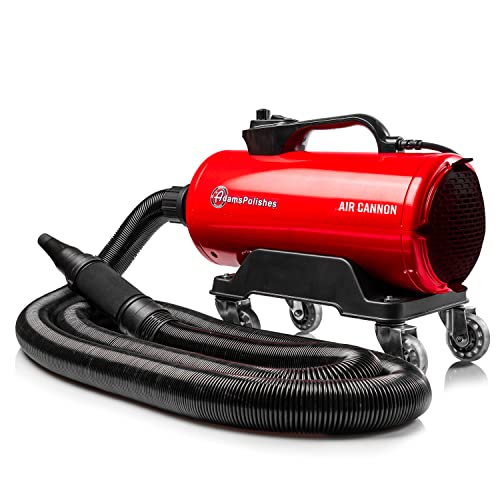
Best for: Touch-free drying of coated cars
Adam’s Polishes Air Cannon is a touch-free car dryer that uses warm, filtered air instead of towels or chamois. That approach can reduce contact with paint and chrome during drying, especially on vehicles with delicate finishes. The unit includes a 30-foot hose that expands for use and retracts for storage.
Its adjustable airflow reaches over 73,000 feet per minute and 392 CFM, giving you control around mirrors, grilles, wheels, and trim. Rubberized fan and pointed attachments help direct the air without scraping nearby surfaces. A 15-foot power cord provides useful reach, while the motor includes noise reduction rated at 88 dB. Around $285, it costs much more than a handheld blower, but the filtered air and long hose may suit regular detailing work. Adam’s lists a one-year manufacturer’s warranty and a 110% satisfaction guarantee.
Pros
- Touch-free warm, filtered air reduces the need to drag towels across paint.
- Adjustable output reaches over 73,000 feet per minute and 392 CFM.
- The 30-foot retractable hose and rubberized tips support precise drying.
Cons
- At 88 dB, the dryer remains loud during use, so hearing protection may be useful.
- Around $285 makes it a costly purchase for occasional home car washing.
1. Adam’s Polishes Mini Air Cannon Car Dryer Blower

Best for: Touch-free drying of coated vehicles
Adam’s Polishes Mini Air Cannon is a handheld forced-air dryer for cars, motorcycles, boats, RVs, and other detailed surfaces. It pushes warm, filtered air across paint, glass, trim, wheels, and tight gaps, reducing the need to drag a towel over wet panels. The unit weighs 3 pounds 2 ounces, so it is easier to move around a vehicle than a full-size shop blower.
Its 1,200-watt motor produces up to 19,000 feet per minute and 90 CFM of airflow. That is enough to clear water from mirrors, grilles, emblems, seams, and wheel spokes. A noise-cut design helps reduce the racket, though this is still a powered blower. The kit includes a fan tip, round tip, and 20-foot reinforced rubberized power cord. At around $105, it costs more than a towel-based drying setup, but it offers a practical option for vehicles with ceramic coatings, delicate finishes, or many hard-to-reach areas. The one-year manufacturer warranty adds some purchase protection.
Pros
- Filtered, warm air helps dry paint without direct towel contact.
- The 20-foot cord gives useful reach around larger vehicles.
- Two nozzle options suit broad panels and narrow gaps.
Cons
- It requires a 120V outlet and cannot operate as a cordless tool.
- The 90 CFM airflow may feel slow on large, flat panels.
Buying Guide
Airflow control is the most important factor in a vehicle drying blower. A useful unit should move enough air to clear water from seams without forcing grit across delicate paint or trim.
- Air volume: Look for at least 70 CFM for general drying, or 100 CFM and higher for large SUVs and trucks. A variable-speed trigger gives better control around badges, mirrors, and sensors.
- Air speed: Choose roughly 100 to 150 mph at the nozzle. Higher speed helps with grilles and wheels, while a lower setting suits loose decals and soft convertible tops.
- Power source: Cordless models should provide 15 to 30 minutes of useful runtime per battery. A 5.0Ah pack usually suits one vehicle, while a second pack helps with larger vehicles.
- Nozzle design: Pick a rubber-tipped nozzle between 1 and 2 inches wide, plus a narrow tip for lug nuts and panel gaps. Rubber reduces scratch risk if it touches paint.
- Noise and cost: Aim for 70 dB or less when possible. Expect about $100 to $250 for a capable cordless unit, with batteries sometimes sold separately.
If you must compromise, prioritize adjustable airflow over peak speed, since control protects paint and reaches more areas safely.
Frequently Asked Questions
How powerful should a blower be for car detailing?
A car-detailing blower should deliver controlled airflow rather than maximum power alone. Look for variable speed, a narrow nozzle, and enough battery life to clear water from mirrors, grilles, and wheel spokes. For cordless models, 20 to 30 minutes of usable runtime usually covers one vehicle, while corded units suit longer sessions.
What nozzle works best for drying a car?
The most useful nozzle is a narrow, rubber-tipped nozzle that concentrates air without scratching paint. The tip should stay slightly away from the surface, especially around badges, trim, and soft convertible tops. A 10 to 15 millimeter outlet gives better control than a wide opening when pushing water from panel gaps.
Can a leaf blower be used for car cleaning?
Yes, a leaf blower can dry a car, but a detailing blower offers better control and cleaner air. Use the leaf blower on low speed, keep it 12 inches from paint, and avoid dusty garage floors. Dedicated units often include small tips for mirrors, emblems, and grilles.
Are cordless blowers good for car detailing?
Cordless blowers are convenient for car cleaning, but corded models usually provide longer sessions and steady power. A battery unit works well for one or two vehicles if its pack lasts at least 20 minutes. Pick corded equipment for frequent shop use, and check whether the cable reaches 25 feet or more.
Conclusion
Adam’s Polishes Mini Air Cannon Car Dryer Blower is the top pick for detailers who want a compact, focused tool for mirrors, grilles, badges, and other tight areas. If your priority is faster drying across a full-size vehicle, choose a more powerful blower with a longer hose and higher airflow instead. Before buying, double-check the unit’s size, nozzle and hose compatibility, included quantity, and current price, since packages and discounts can change. This mini dryer makes the most sense when storage space matters and you already have a larger towel or dryer for broad panels. Keep expectations realistic: a small blower may need extra passes around wheels, trim, and seams. The right choice depends on your vehicle size, garage setup, and detailing routine.